


AI in Retail: From Personalization to Inventory Optimization

Why Should Retail Leaders Prioritize AI Now?
As consumer expectations evolve and operational complexities increase, artificial intelligence has emerged not as a luxury but as a competitive necessity. The numbers tell a compelling story: the global AI in retail market reached approximately $11.61 billion in 2024 and is projected to grow to $40.74 billion by 2030, reflecting a compound annual growth rate that signals widespread adoption across the industry.
Traditional approaches to inventory management, customer engagement, and pricing strategies are proving insufficient in an era where consumer preferences shift rapidly and market conditions change overnight.
The performance gap between AI adopters and traditionalists is widening. Retailers using AI and machine learning technologies saw double-digit sales growth in both 2023 and 2024, with annual profit growth of approximately eight percent, significantly outperforming competitors without these technologies.
What drives this transformation? Three converging forces:
- Consumer Expectations Evolution: Today's shoppers demand personalized experiences across every touchpoint. Generic product recommendations and one-size-fits-all marketing no longer suffice. Customers expect retailers to understand their preferences, anticipate their needs, and deliver seamless experiences whether they're shopping online, via mobile, or in-store.
- Operational Complexity: While physical stores remain vital, their purchase share is declining from 45% in 2024 to a projected 41% by 2026, with digital spending fragmenting across marketplaces, retailer websites, brand sites, and delivery apps. Managing inventory, pricing, and customer experiences across these fragmented channels requires intelligence that scales beyond human capacity.
- Competitive Pressure: According to Stanford's AI Index, 78% of organizations reported using AI in 2024, up from 55% the year before. Retailers who delay AI adoption risk falling permanently behind competitors who are already leveraging these capabilities.
What Are The Core Benefits Of AI In Retail?
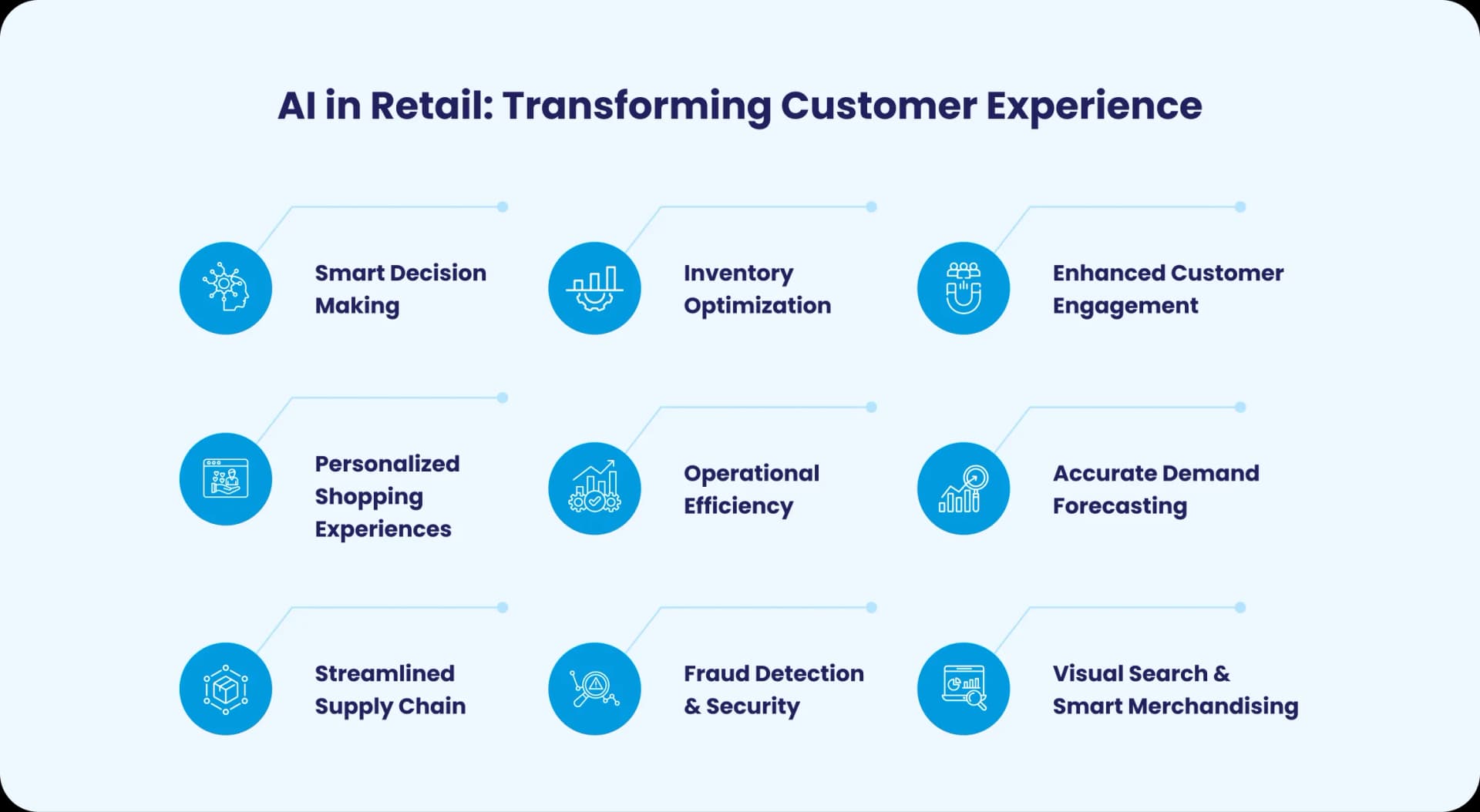
AI improves decision-making with predictive analytics, reduces waste via optimized inventory, and fosters innovation in customer interactions. For instance, 90% of companies report using AI, yet many remain in pilot stages, highlighting the need for scalable implementations.
In retail, AI delivers even greater value by enabling accurate demand forecasting to prevent stockouts and overstocking, optimizing inventory management through real-time insights, and creating personalized shopping experiences that strengthen customer loyalty.
It also enhances engagement with AI-powered chatbots and virtual assistants, streamlines supply chain operations, and supports dynamic pricing strategies to stay competitive. Advanced features like fraud detection and visual search further improve security and convenience, making AI a powerful driver of efficiency and innovation.
However, challenges like data privacy and integration hurdles persist, making expert guidance valuable.
How Can AI Address Common Retail Challenges?
From fluctuating demand to omnichannel complexities, AI offers data-driven solutions. It supports empathetic approaches by personalizing without intrusiveness, respecting diverse customer preferences and ethical considerations.
As retail executives navigate an increasingly competitive landscape, AI emerges as a transformative force, reshaping everything from customer interactions to backend operations.
This comprehensive exploration delves into AI's applications in retail, drawing on the latest industry reports, real-world case studies, and forward-looking insights. We'll examine how AI enables hyper-personalized shopping experiences, streamlines inventory management, and drives operational efficiency, while emphasizing the critical role of data security and ethical practices.
Unlike generic overviews that recycle familiar examples, this piece differentiates by integrating perspectives on AI security and consulting strategies tailored for enterprise leaders, highlighting how secure, data-centric AI implementations can yield sustainable ROI. We'll also spotlight emerging trends like agentic AI, providing actionable advice for decision-makers in medium to large organizations.
How Is AI Revolutionizing The Retail Sector?
The retail industry is undergoing a seismic shift, propelled by AI technologies that promise enhanced efficiency and customer satisfaction.
According to McKinsey's State of AI Global Survey 2025, 90% of companies now use AI in some capacity, up from previous years, though 67% are still in experimental phases. This adoption is driven by AI's ability to process vast datasets in real-time, uncovering insights that human analysis alone cannot achieve.
The global AI in retail market is expected to reach $14.24 billion in 2025, growing at a CAGR of 46.5% to $96.13 billion by 2030. Generative AI alone could add $240-390 billion in value to retail operations, per McKinsey estimates.
Retailers are leveraging ML, NLP, and computer vision to create seamless omnichannel experiences.
However, AI's true value lies not just in automation but in fostering resilient, secure data ecosystems. For high-level decision-makers, this means viewing AI as a strategic asset that integrates with existing enterprise systems, mitigating risks like data breaches that could cost retailers millions. Gartner predicts that by 2028, over 50% of enterprises will adopt AI security platforms to safeguard their investments.

How Are Leading Retailers Using AI For Hyper-Personalization?
Personalization has evolved far beyond addressing customers by name in email campaigns. Today's AI-powered personalization engines analyze vast datasets. From browsing behavior, purchase history, and demographic information to contextual factors, and even external signals like weather and social trends, are being tracked and used deliver experiences that feel genuinely tailored to individual preferences.
The Walmart Approach: Adaptive Retail at Scale
Walmart's transformation illustrates the power of comprehensive AI integration. The retail giant unveiled its "Adaptive Retail" strategy in October 2024, deploying proprietary AI and generative AI platforms to create what CEO Doug McMillon describes as experiences that bring "shopping to customers in exactly the ways they want and need."
The results speak volumes. Walmart's AI-driven shopper segmentation and targeting capabilities increased conversion rates by 6.2%, while omnichannel shoppers spend an average of $1,043 compared to $839 for in-store-only shoppers. This isn't about incremental improvement, it's about fundamentally reimagining the customer journey.
Walmart's generative AI-powered search function exemplifies this transf@ormation. Instead of forcing customers to conduct multiple searches for related items, the system understands context and intent. A customer planning a themed party can simply ask, "Help me plan a flower-themed party for my family member," and receive curated recommendations across multiple product categories, everything from decorations to tableware to food items.
The company's Content Decision Platform serves personalized shopping experiences aligned with their Digital Trust Commitments and Responsible AI Pledge. When customers visit Walmart's website, AI technologies understand their preferences while generative AI predicts the type of content they'd like to see. If someone previously searched for board games, they see relevant deals, new releases, and gift ideas without having to explicitly request them.
Sephora: Bridging Digital and Physical Beauty Experiences
Sephora faced a challenge familiar to many specialty retailers, “how to replicate the tactile, experiential nature of in-store shopping in digital channels.” Makeup and beauty products are inherently visual and subjective. Colors appear differently across skin tones, textures vary, and lighting affects perception. Online purchases carried high uncertainty and correspondingly high return rates.
The company's solution, Virtual Artist, launched in partnership with ModiFace, combines augmented reality with AI to simulate real-time makeup application. AI algorithms analyze facial geometry, identify features such as lips, eyes, and cheekbones, and apply digital makeup with remarkable precision while adjusting for skin tone and ambient lighting.
The impact has been substantial. Virtual Artist increased conversion rates by 11% and reduced product returns by 30%. Within two years of launching, Sephora Virtual Artist saw over 200 million shades tried on and over 8.5 million visits to the feature.
But Sephora didn't stop with virtual try-ons. Their Color IQ system uses a handheld device to scan skin and assign a scientifically precise color match, connecting customers to compatible foundation shades across their entire product range. Skincare IQ provides personalized consultations based on individual skin concerns, needs, and preferences. These AI-powered tools allow in-store staff to focus on higher-value consultative interactions, while technology handles precise matching and product discovery.
The Common Thread: Data-Driven Personalization
Key learnings from these can be summarized as:
- Unified Customer Data: Successful personalization requires breaking down data silos. Retailers must consolidate information from point-of-sale systems, e-commerce platforms, mobile apps, loyalty programs, and customer service interactions into a single, comprehensive view of each customer.
- Real-Time Responsiveness: Static personalization rules quickly become obsolete. Modern AI systems continuously learn from customer behavior, adjusting recommendations and content in real-time as preferences evolve.
- Cross-Channel Consistency: Customers don't think in channels—they think in journeys. AI enables retailers to maintain consistent, personalized experiences whether customers are browsing on mobile, shopping in-store, or engaging through social media.
- Privacy-Conscious Implementation: With increasing regulatory scrutiny around data privacy, successful retailers implement AI personalization within clear ethical frameworks, providing transparency about data usage and offering customers meaningful control over their information.
For enterprise decision-makers, it’s imperative to understand that personalization requires a fundamental rethinking of how customer data flows through the organization, and how that intelligence informs every customer touchpoint.

How Can AI Optimize Inventory Management In Retail?
While personalization captures headlines, AI's impact on inventory management and supply chain optimization may deliver even more dramatic ROI. The fashion industry alone faces staggering inefficiency. Brands produced 2.5 to 5 billion excess garments globally in 2023, with unsold stock worth $70 billion to $140 billion sitting in warehouses, and brands lost up to 20% of monthly profits due to inaccurate stock buying.
Zara's Just-In-Telligent Supply Chain
Zara, the Spanish fast-fashion giant, has become a case study in AI-powered agility. The company faced the challenge of fashion trends changing rapidly, customer preferences varying by region, and traditional forecasting methods that were based on historical data and seasonal patterns, couldn't keep up with the speed of modern cycles.
Zara's solution, which they call a "Just-In-telligent" supply chain combines just-in-time inventory principles with AI-powered real-time analytics. The system monitors real-time data, predicts customer demand, and dynamically optimizes stock levels, enabling rapid turnaround of new designs in as little as one week.
The results are industry-leading. Zara sells 85 percent of its items at full price compared to the industry average of 60 percent, and the company takes only 10 to 15 days to go from design stage to sales floor. While competitors are heavily discounting last season's inventory, Zara is selling current merchandise at full margin.
How does this work in practice? Zara embedded RFID microchips in security tags across its clothing, providing real-time visibility into where every garment is throughout the supply chain, from production through sale. AI algorithms analyze this data alongside sales patterns, weather forecasts, social media trends, and store manager feedback to predict demand at a granular level.
If a particular jacket style is selling rapidly in New York but slowly in Miami, the AI system can automatically redirect inventory between locations without waiting for manual intervention. If weather forecasts predict an early cold snap in a region, the system preemptively adjusts stock levels for outerwear. This dynamic allocation ensures popular items remain available while minimizing markdowns on slow-moving inventory.
The Broader Benefits Of AI-Powered Inventory Optimization
Zara's approach illustrates broader principles that apply across retail categories:
- Demand Forecasting Accuracy: AI-powered retailers achieve 95% demand forecasting accuracy, 40% lower inventory costs, and 60% fewer stockouts. This level of precision dramatically reduces both the risk of stockouts (lost sales and customer dissatisfaction) and overstock (markdowns and carrying costs).
- Reduced Lead Times: AI enables faster decision-making by continuously analyzing multiple data streams and recommending actions. Rather than waiting for monthly or quarterly reviews, inventory adjustments happen in near-real-time.
- Sustainability Impact: Better inventory management isn't just good business—it's environmentally responsible. By reducing overproduction and minimizing waste, AI-powered supply chains align profit with purpose. Zara has focused on intelligent decarbonization, using machine learning to optimize transportation routes, enhance energy efficiency in production, and source from sustainable suppliers.
- Risk Mitigation: AI systems can monitor for supply chain disruptions—tracking supplier performance, geopolitical risks, weather events, and logistics challenges—and recommend alternative suppliers or routes before problems impact operations.
For enterprises implementing AI in supply chain management, integration is critical. These systems must connect with existing ERP platforms, warehouse management systems, transportation management systems, and demand planning tools. The most successful implementations take a phased approach, starting with high-impact, lower-complexity use cases like demand forecasting, then expanding to dynamic allocation and automated replenishment as capabilities mature.
What Role Does Predictive Analytics Play In Retail Decision-Making?
AI-powered predictive analytics is transforming how retailers make strategic decisions across pricing, marketing, merchandise planning, and store operations.
Dynamic Pricing and Promotion Optimization
Traditional pricing strategies relied on cost-plus calculations, competitive monitoring, and periodic promotional calendars. AI-powered dynamic pricing considers dozens of variables simultaneously: competitor pricing, inventory levels, demand elasticity, customer segments, time of day, weather conditions, and market trends.
Walmart's AI-powered dynamic pricing system during Black Friday 2024 continuously tracked competitor prices and automatically adjusted pricing to stay competitive, resulting in significantly higher sales performance compared to previous years using manual pricing strategies.
The sophistication extends beyond simple price matching. AI algorithms can identify which products are price-sensitive (where small changes significantly impact demand) versus prestige items (where premium pricing reinforces brand perception). They can optimize promotional timing, determining when markdowns will maximize revenue versus when holding prices steady preserves margin.
Store Operations & Workforce Planning
AI helps retailers optimize store operations through:
- Traffic Forecasting: Predicting foot traffic patterns allows better workforce scheduling, ensuring adequate staffing during peak periods while controlling labor costs during slower times.
- Layout Optimization: Computer vision and AI analyze how customers navigate stores, which displays attract attention, and where bottlenecks occur. These insights inform store layout decisions that improve customer experience and maximize sales per square foot.
- Loss Prevention: AI-powered video analytics can identify potential theft patterns, unusual behaviors, and process violations without requiring continuous human monitoring. Sam's Club deployed AI and computer vision technology across all locations to automatically verify purchases as members leave, with over 64% of members enjoying the friction-free exit experience and leaving the club 21% faster.
Marketing Campaign Optimization
AI transforms marketing from art to science, or more accurately, combines both. Machine learning algorithms analyze which messages resonate with which customer segments, optimal timing for communications, and most effective channels for engagement.
Adoption is highest in personalization at 71%, marketing automation at 48.9%, and chatbots at 31%. These aren't separate initiatives but integrated capabilities that work together. A customer browsing winter coats on mobile might receive a personalized email highlighting specific styles in their size and preferred colors, delivered at the optimal time based on their historical engagement patterns, with copy generated by AI trained on high-performing past campaigns.
Why Is Data Security Crucial In AI-Driven Retail Strategies?
As AI relies on sensitive customer data, security is paramount. Retailers face risks like data leaks, with the average breach costing $4.45 million in 2025. AI security involves encrypting data pipelines, using federated learning to train models without centralizing data, and implementing bias audits.
Gartner's Top Data, Analytics, and AI Trends for Retail CIOs in 2025 emphasize AI trust, risk, and security management (TRiSM) as a priority. For enterprises, this means partnering with AI consultants like xLoop to deploy secure LLMs and predictive analytics, ensuring compliance and robustness.
What Future Trends In AI Will Shape Retail?
Looking ahead, agentic AI (autonomous agents capable of orchestrating shopping tasks) could transform retail, with McKinsey projecting $1 trillion in U.S. retail revenue by 2030. These agents will handle everything from personalized product discovery to automated purchasing, creating frictionless experiences.
Other key trends include:
- Ambient Computing for In-Store Experiences: Smart environments powered by AI will enable seamless interactions, such as voice-activated assistance and real-time product recommendations as customers browse.
- Multimodal AI for Immersive Personalization: Retailers will integrate Vision, Mission and Text to deliver hyper-personalized experiences across channels—think virtual try-ons combined with conversational shopping assistants.
- AI Governance Platforms: As AI adoption accelerates, retailers will need robust governance frameworks to ensure compliance, ethical use, and transparency in automated decision-making.
- Sustainability Through AI: With growing consumer demand for eco-friendly practices, AI will optimize supply chains to reduce carbon footprints by 10-15%, improve energy efficiency, and minimize waste.
- Predictive Inventory & Dynamic Pricing: Advanced AI models will forecast demand with near-perfect accuracy and adjust pricing dynamically based on real-time market conditions, reducing overstock and markdown losses.
- Generative AI for Content & Product Design: Expect AI-driven creative tools to design marketing campaigns, personalized product recommendations, and even new product concepts tailored to customer preferences.
How Can Enterprises Implement AI Effectively In Retail?
Successful implementation requires a phased approach: assess needs, pilot solutions, scale with metrics. Collaborate with experts for custom integrations. At xLoop Digital, our AI services in retail help enterprises deploy secure, scalable solutions from predictive analytics to GenAI.
Conclusion
Retailers are deepening their commitment to AI, with 76% saying they're increasing investment over the next year. The gap between leaders and laggards will widen rapidly.
AI in retail offers immense potential, but realizing it demands strategic, secure approaches. By focusing on personalization, inventory optimization, and emerging trends, enterprises can thrive in 2025 and beyond.
The most successful retailers aren't waiting for perfect conditions or comprehensive roadmaps. They're starting with targeted use cases, learning from implementation, and scaling what works. They're investing in data infrastructure that enables AI. They're building partnerships that provide expertise while developing internal capabilities. Most importantly, they're viewing AI not as a technology project but as a strategic transformation that touches every aspect of their business.
For retail executives, the imperative is to understand the art of what’s possible, identifying where AI can drive the most value in your specific context, and begin the journey. The retailers who act decisively today will define the competitive landscape of tomorrow.

Explore how AI can transform your retail operations
Our team combines deep retail industry knowledge with cutting-edge AI expertise to deliver solutions that drive measurable business impact.
FAQs
Frequently Asked Questions

Table of Contents
Newsletter Signup
Tomorrow's Tech & Leadership Insights in
Your Inbox
Discover New Ideas

7 AI Use Cases South African Enterprises Are Investing In

Using AI Agents in DevOps to Automate CI/CD, Incident Response, & Root Cause Analysis

Is Your AI Actually Secure? What Enterprise Leaders Need to Know in 2026

Knowledge Hub