


How AI Transforms Strategic Decision Making

We've all been there—drowning in reports, metrics, and competing recommendations while trying to make decisions that could shape our company's future.
The irony?
We have more business intelligence than ever, yet strategic decision-making feels harder than it used to be.
Here's what we've learned from working with hundreds of organizations: the challenge isn't getting access to data anymore. It's cutting through the noise to find what actually matters for your next big move.
You're facing the same reality we see across industries. While AI is quickly becoming essential to how companies operate according to PwC's October 2024 Pulse Survey, most organizations still struggle with the gap between having data and making confident strategic decisions.
The solution isn't just better data—it's smarter processing. And that's exactly where AI stops being a nice-to-have, and becomes your strategic advantage.

1. The Strategic Decision-Making Crisis
Modern businesses generate data at unprecedented rates.
Customer interactions, market trends, operational metrics, competitor activities—the information streams never stop. Yet paradoxically, this abundance creates paralysis rather than clarity.
Consider these common scenarios:
- Edge Computing Integration: Modern systems can run sophisticated computer vision models directly on local devices, reducing latency and improving privacy while lowering cloud computing costs.
- Transfer Learning: Pre-trained models can be quickly adapted for specific business applications, dramatically reducing development time and data requirements.
- Multi-Modal AI: Integration with natural language processing and other AI technologies creates more comprehensive and actionable insights from visual data.
Traditional decision-making processes, relying on intuition and limited data analysis, simply cannot keep pace with the complexity and speed of modern business environments.
Organizations that embrace data-driven decision making consistently outperform their competitors in both speed and accuracy of strategic choices.

2. How AI Revolutionizes Strategic Decision Making
Artificial intelligence doesn't replace human judgment—it amplifies it.
By processing vast amounts of data, identifying patterns, and modeling scenarios, AI provides the foundation for more informed, faster, and more accurate strategic decisions.
1. Data Integration and Pattern Recognition
AI excels at connecting dots across disparate data sources.
While humans might analyze data sources like sales reports and customer service data separately, AI can identify correlations between customer complaints and revenue trends, revealing insights that would otherwise remain hidden.
For example, an AI system might detect that customers who experience support delays are 40% more likely to reduce their order frequency—information that could reshape your customer service investment strategy.
2. Predictive Analytics and Scenario Modeling
Rather than relying on historical data alone, AI can model multiple future scenarios based on current trends and potential changes. This capability is particularly valuable for strategic planning, where decisions made today impact outcomes months or years in the future.
AI can simulate how different strategic choices might play out under various market conditions, helping leaders understand not just what to do, but what might happen if they do it.
3. Real-Time Decision Support
Strategy requires mobilizing the organization, ensuring the right allocation of resources, and monitoring execution. In all these tasks, AI can play a role. Unlike traditional quarterly reviews, AI provides continuous monitoring and adjustment recommendations, allowing strategies to evolve as conditions change.

3. The Human-AI Collaboration Framework
The most successful strategic decision-making combines human insight with AI capabilities.
Here's how this collaboration works in practice:
AI Handles the Heavy Lifting
- Processing large datasets quickly
- Identifying statistical patterns and correlation
- Running complex scenario analyses
- Monitoring key performance indicators continuously
- Flagging anomalies and emerging trends
Humans Provide Context and Judgment
- Understanding industry nuances and cultural factors
- Evaluating ethical implications and stakeholder impact
- Making final decisions based on values and long-term vision
- Communicating and implementing strategic changes
- Adapting strategies based on qualitative insights
The primary consideration should be ensuring AI doesn't harm people, which often means keeping humans in the loop until AI systems prove themselves significantly safer than human decision-makers.

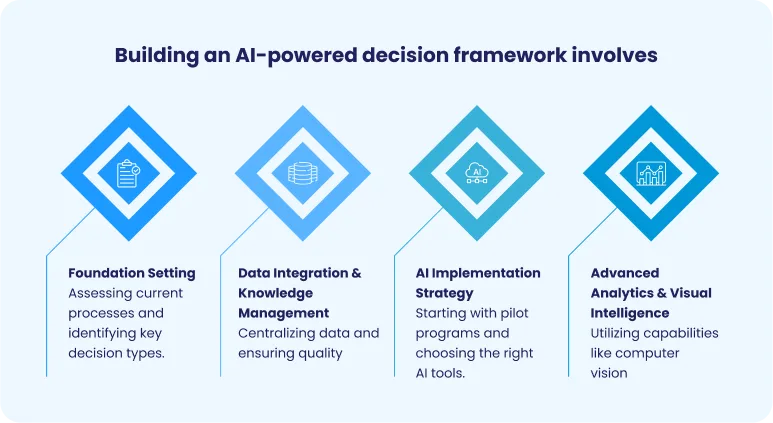
4. Practical Implementation: Building Your AI-Powered Decision Framework
The most successful strategic decision-making combines human insight with AI capabilities.
Here's how this collaboration works in practice:
Phase 1: Foundation Setting
Assess Your Current Decision-Making Process
Before implementing AI, understand how decisions are currently made in your organization. Map out:
- Who participates in strategic decisions
- What data sources are currently used
- How long decisions typically take
- Where bottlenecks occur
Identify Key Decision Types
Not all decisions require AI support. Focus on:
- Recurring strategic choices (market entry, resource allocation)
- Decisions involving multiple variables and stakeholders
- Time-sensitive opportunities requiring rapid analysis
- Choices where the cost of being wrong is high
Phase 2: Data Integration and Knowledge Management
This is where sophisticated knowledge management becomes crucial. Your AI system is only as good as the data it can access and the knowledge it can leverage.
A comprehensive knowledge management platform can serve as the foundation for AI-powered decision making by:
- Centralizing data from multiple sources (CRM, ERP, market research, customer feedback)
- Ensuring data quality and consistency
- Making institutional knowledge accessible to AI systems
- Providing context and historical perspective for current decisions
Phase 3: AI Implementation Strategy
Start with Pilot Programs
Begin with lower-risk decisions where AI can demonstrate value without significant consequences if adjustments are needed. This approach builds confidence and allows you to refine your processes.
Choose the Right AI Tools
AI Decisioning platforms analyze your customer data to determine each individual's optimal content, channel, and timing. Select platforms that integrate well with your existing systems and provide transparent reasoning for their recommendations.
Conversational AI for Decision Support
Modern conversational AI platforms can make complex data analysis accessible to decision-makers who aren't data scientists.
Instead of learning complex analytics software, executives can ask natural language questions and receive clear, contextual answers.
For example, instead of running complex queries, a CEO might ask: "What factors are most likely to impact our Q3 revenue, and how should we adjust our strategy?"
The AI can analyze multiple data sources and provide a comprehensive response with supporting evidence.
Phase 4. Advanced Analytics & Visual Intelligence
Beyond traditional data sets, the modern strategic landscape demands the ability to derive insights from visual information.
For decisions involving visual data—such as dynamic market trends, intricate operational workflows, or nuanced customer behavior patterns—computer vision capabilities add a powerful and often overlooked dimension to strategic analysis. Visual intelligence platforms, like xVision, can:
Analyze customer behavior patterns from video data
Move beyond surveys to understand actual customer engagement within physical spaces, product interaction, or in-store navigation, providing granular insights that inform merchandising, store layout, and customer service strategies.
Monitor competitor activities through image recognition
Gain competitive edge by tracking product placements, promotional displays, and new offerings in real-time across physical and digital channels, allowing for rapid strategic adjustments.
Track operational efficiency through visual workflow analysis
Optimize processes by visually identifying bottlenecks, inefficiencies, and safety hazards in manufacturing, logistics, or service delivery, leading to streamlined operations and cost savings.
Identify emerging trends through social media and visual content analysis
Leverage the vast ocean of public visual data to spot nascent fashion trends, lifestyle shifts, or product preferences long before they hit traditional reports, enabling proactive product development and marketing.
By integrating these advanced visual analytics, businesses can uncover hidden correlations, anticipate market shifts, and make more holistic strategic decisions, moving from reactive responses to proactive leadership.
5. Measuring Success: KPIs for AI-Enhanced Decision Making
Track these metrics to evaluate the effectiveness of your AI-powered decision-making:
Speed Metrics
- Time from data collection to decision implementation
- Reduction in analysis time for complex decisions
- Faster identification of strategic opportunities
Accuracy Metrics
- Percentage of decisions that achieved intended outcomes
- Reduction in strategic pivots due to unforeseen consequences
- Improved forecast accuracy for strategic planning
Quality Metrics
- Stakeholder satisfaction with decision processes
- Comprehensive consideration of relevant factors
- Better alignment between decisions and long-term strategy

6. Overcoming Common Implementation Challenges
Data Quality and Integration Issues
Poor data quality undermines AI effectiveness. Invest in data governance and establish clear standards for data collection and maintenance.
Resistance to Change
Some team members may resist AI-supported decision making. Address concerns through education, transparency about AI recommendations, and gradual implementation.
Over-Reliance on AI
AI systems, when properly trained, provide valuable insights, but shouldn't replace human judgment entirely. Maintain balance between AI recommendations and human insight.
Integration Complexity
Choose AI platforms that integrate well with existing systems rather than requiring complete infrastructure overhauls.

7. The Future of Strategic Decision Making
AI will continuously learn from new data, improving its decision-making capabilities over time.
This will allow businesses to rely on AI models that are constantly evolving, ensuring that decisions are made based on the latest available data and trends.
Looking ahead, we can expect:
- More sophisticated predictive modeling
- Better integration between different AI systems
- Increased accessibility of advanced analytics
- Greater emphasis on ethical AI decision-making

8. Getting Started: Your Next Steps
Audit Your Current Decision-Making Process
More sophisticated predictive modeling
Establish Data Infrastructure
Ensure you have quality data sources and proper integration
Choose Pilot Projects
Start with lower-risk decisions to build confidence and expertise
Invest in the Right Platforms
Select AI tools that integrate with your existing systems and support your specific needs
Train Your Team
Ensure decision-makers understand how to work effectively with AI systems
Measure and Iterate
Continuously improve your AI-powered decision-making processes
9. Conclusion
The future belongs to organizations that can make better decisions faster.
AI doesn't replace human strategic thinking—it amplifies it, providing the data processing power and analytical capabilities that modern strategic decision-making requires.
By combining sophisticated knowledge management, conversational AI interfaces, and advanced analytics capabilities, organizations can transform their decision-making from reactive to proactive, from gut-feel to data-driven, and from slow to swift.
The question isn't whether AI will transform strategic decision making—it's how quickly your organization will embrace this transformation and gain the competitive advantage it provides.

Ready to unlock your organization's full strategic potential?
Contact our team to discuss how AI can deliver value for your organization.

Table of Contents
Newsletter Signup
Tomorrow's Tech & Leadership Insights in
Your Inbox
Discover New Ideas

7 AI Use Cases South African Enterprises Are Investing In

Using AI Agents in DevOps to Automate CI/CD, Incident Response, & Root Cause Analysis

Is Your AI Actually Secure? What Enterprise Leaders Need to Know in 2026

Knowledge Hub