


NLP Advancements: Enhancing Customer Experiences in the Age of AI
Remember the last time you interacted with a chatbot that kept repeating "I didn't understand that" no matter how many different ways you phrased your question? Those days are rapidly disappearing. Today's AI-powered customer service tools can understand context, detect emotions, and provide relevant answers that feel surprisingly human.
The transformation from rigid keyword-matching systems to sophisticated natural language processing has fundamentally changed how businesses interact with their customers. Early chatbots operated like overly literal robots, breaking down at the slightest deviation from their programmed scripts. Modern NLP systems powered by large language models can handle typos, understand slang, maintain context across conversations, and even detect when a customer is frustrated.
This evolution represents more than just technological progress. Recent breakthroughs in NLP, including zero-shot learning and chain-of-thought reasoning, have shifted customer experience from reactive problem-solving to proactive, personalized engagement. Companies implementing these technologies are seeing measurable impacts on both customer satisfaction scores and revenue. The question is no longer whether to adopt NLP in customer service, but how to implement it effectively.
How Is Generative AI Transforming the Way Businesses Talk to Customers?
Generative AI transforms customer interactions by moving from rigid scripts to fluid, context-aware conversations. By leveraging Large Language Models (LLMs), businesses can provide human-like responses that handle slang and ambiguity, increasing autonomous query resolution by up to 70% while reducing customer wait times.
Traditional customer service systems relied on decision trees. Every conversation followed predetermined paths, with agents or bots selecting from fixed response options based on keywords. If a customer strayed from the expected script or used unexpected phrasing, the entire interaction could derail.
Generative AI has eliminated these rigid structures. Modern NLP systems engage in fluid, dynamic conversations that adapt to how each customer naturally communicates. They handle ambiguity without breaking stride. A customer might type "my thing isn't working" with minimal detail, and the system can ask clarifying questions in a natural way rather than presenting a confusing menu of options.
Context retention represents another major shift. Advanced NLP systems remember previous interactions across channels. When you contact support today about an issue you raised last week, the system already knows your history. It understands you were frustrated about a delayed shipment, that you were promised a resolution by Friday, and that you're a long-term customer who rarely complains. This continuity transforms isolated support tickets into ongoing customer relationships.
The efficiency gains are substantial. Advanced NLP implementations resolve approximately 80% of customer queries without human intervention. These aren't just simple FAQ responses. The systems handle account changes, troubleshoot technical issues, process returns, and provide personalized product recommendations. For customers, this means dramatically reduced wait times. For businesses, it means support teams can focus on complex cases that genuinely require human judgment.
What Are the Breakthrough NLP Technologies Reshaping Interactions Today?
Current breakthroughs include Transformer architectures, Retrieval-Augmented Generation (RAG), and Agentic AI. These technologies allow systems to fetch real-time company data and execute complex tasks across multi-turn dialogues, ensuring responses are both accurate and actionable.
The transformer architecture revolutionized how machines understand language. Unlike previous models that read text sequentially from left to right, transformers process entire sentences simultaneously while understanding how each word relates to every other word. This bidirectional reading allows systems like BERT and GPT to grasp context and nuance that earlier models missed entirely.
Think about the sentence "I saw her duck." Does it mean you observed her aquatic pet, or watched her lower her head? Transformer models consider the surrounding context to determine meaning, much like humans do. This capability forms the foundation for every major NLP advancement in customer service today.
Agentic AI represents the cutting edge of customer experience technology in 2026. These systems go beyond conversation to act. When a customer says "I need to return this and get a refund," an agentic AI system can verify the purchase, generate a return label, initiate the refund process, and update multiple backend systems while maintaining a natural dialogue. The AI acts as an autonomous agent with the authority to complete transactions, not just provide information. For instance, Salesforce's Agentforce autonomously resolved 70% of chat engagements for 1-800Accountant during peak tax season.
These agentic systems excel at multi-turn conversations where customers have complex, evolving needs. A single interaction might involve checking order status, modifying a shipping address, adding items to a subscription, and scheduling a follow-up call. The AI maintains context throughout, understanding how each request relates to the others and adjusting its approach accordingly.
Retrieval-Augmented Generation has solved one of the most critical problems in AI customer service: hallucinations. Early generative AI systems would occasionally invent plausible-sounding but completely incorrect information. RAG addresses this by connecting language models to real-time databases and knowledge bases. Before answering, the system retrieves current, verified information about inventory levels, policy details, account status, or technical specifications. This grounds responses in factual data rather than relying solely on patterns learned during training.
Can NLP Systems Detect Customer Emotions and Respond Appropriately?
Modern NLP utilizes "Emotion AI" to detect nuances like frustration, sarcasm, and urgency. By analyzing tonal and textual cues, these systems can adjust their empathetic response levels or trigger a seamless handoff to a human agent when emotional stakes escalate.
Sentiment analysis has evolved far beyond simple positive-negative classifications. Modern emotion AI detects nuanced emotional states including frustration, urgency, confusion, satisfaction, and even sarcasm. The system analyzes word choice, sentence structure, punctuation patterns, and conversation flow to understand not just what customers are saying but how they feel.
This emotional intelligence enables appropriate response modulation. When a customer expresses frustration, the AI adjusts its tone to be more formal and apologetic. It might offer immediate escalation options or provide more detailed explanations. Conversely, when interacting with a satisfied customer making a routine inquiry, the system maintains a friendly, efficient tone that respects their time.
The practical applications extend to human agent support. Real-time emotion detection tools monitor ongoing conversations and alert agents when a customer's emotional state deteriorates. An agent handling multiple chats simultaneously receives a notification that Customer A is becoming increasingly frustrated, allowing them to prioritize that interaction and potentially prevent churn.
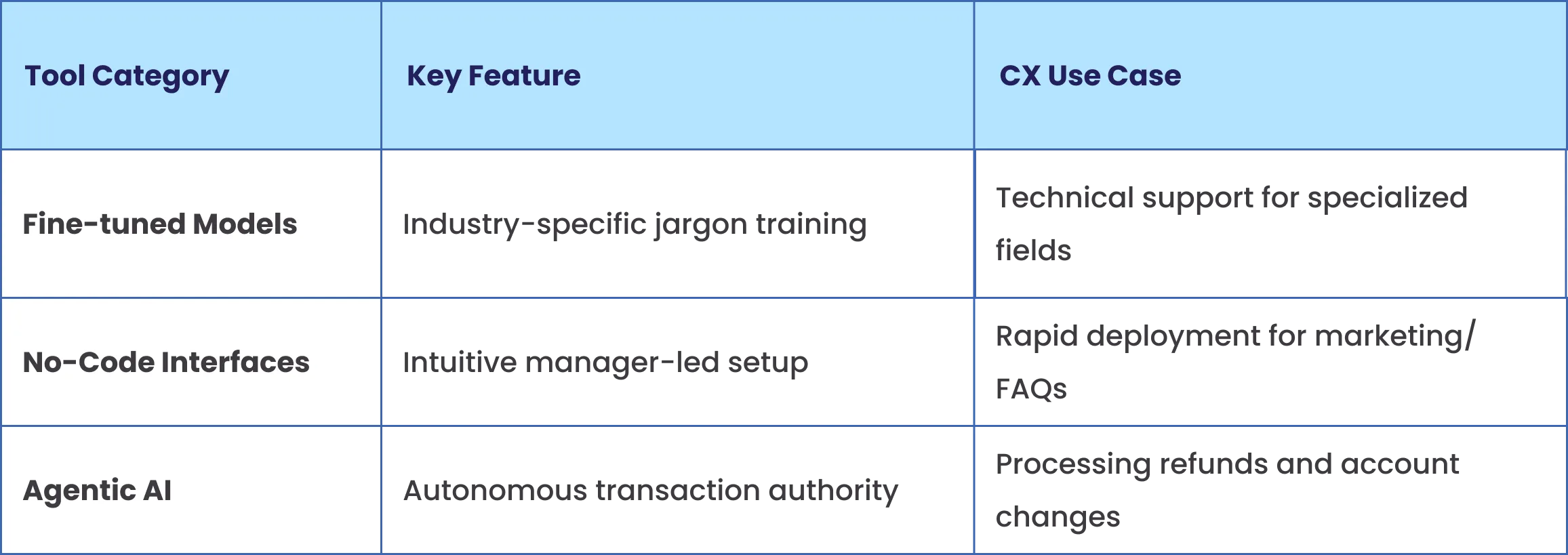
Leading NLP tools for sentiment analysis and customer experience now offer varying capabilities. Some specialize in custom fine-tuning, allowing businesses to train models on their specific industry language and customer base. Others provide no-code interfaces where customer service managers can set up sophisticated emotion detection without technical expertise. Use cases range from intelligent ticket routing, where angry customers automatically reach senior agents, to churn prediction models that identify at-risk customers based on emotional patterns in their communications.
How Does NLP Enable Real-Time Hyper-Personalization at Scale?
NLP enables hyper-personalization by analyzing unstructured data from chat histories and reviews to create dynamic customer profiles. This allows for predictive support, where AI anticipates needs and offers proactive solutions, such as troubleshooting a billing issue before the customer reports it.
The concept of treating each customer as a segment of one has moved from marketing theory to operational reality. NLP systems analyze unstructured data across every customer touchpoint including chat transcripts, email exchanges, product reviews, and support tickets. This analysis builds dynamic profiles that capture individual preferences, communication styles, pain points, and needs.
Unlike traditional customer segmentation that groups people into broad categories, NLP-driven personalization recognizes that each customer is unique. One person might prefer detailed technical explanations while another wants quick bullet points. Some customers appreciate friendly banter while others prefer strictly professional interactions. Advanced systems adapt their communication style to match each individual automatically.
Predictive support represents a shift from reactive to proactive customer service. Rather than waiting for customers to report problems, NLP systems identify patterns that indicate emerging issues. The system might detect that a customer has attempted to complete a transaction three times, each attempt ending at the payment screen. It initiates a chat: "I noticed you might be having trouble completing your purchase. Would you like help with the checkout process?" Proactive tactics like this can recover up to 20% of abandoned carts.
Multimodal personalization integrates text, image, and voice data for richer understanding. A customer uploads a photo of a damaged product. The NLP system uses computer vision to identify the specific item and the type of damage, then automatically processes a replacement order while explaining the resolution. This seamless integration of multiple data types creates experiences that feel effortless from the customer perspective.
How Are Multilingual Models Breaking Down Language Barriers?
Multilingual LLMs break barriers through advanced localization and "code-switching" capabilities. Unlike basic translation, these models understand cultural idioms and can process queries that mix multiple languages, providing native-level 24/7 support in over 50 languages.
Code-switching, where speakers mix multiple languages within a single conversation, has traditionally challenged translation systems. Modern multilingual NLP models handle these mixed-language queries naturally. A customer might ask "Puedes ayudarme with my order?" combining Spanish and English, and the system understands and responds appropriately without treating it as an error.
Beyond word-for-word translation, these models understand cultural context and regional idioms. A phrase that's polite in one culture might be considered rude in another. Quality multilingual NLP systems adjust not just language but cultural tone, ensuring interactions feel native rather than translated.
The business implications are significant. Companies can provide authentic, high-quality customer support in multiple languages without maintaining localized support teams in every region. A customer in Tokyo receives the same quality service at 3 AM as someone in New York during business hours. This 24/7 global coverage was previously feasible only for the largest enterprises, but NLP has made it accessible to mid-sized companies as well. Multilingual support boosts conversions, with localized sites seeing up to 40% higher rates in new markets.
Where Should Businesses Draw the Line Between AI and Human Support?
Determining which interactions belong to AI and which require human agents remains a critical strategic decision. The human-in-the-loop approach recognizes that certain scenarios demand human judgment, empathy, and creative problem-solving that current AI cannot replicate.
High-stakes situations involving significant financial impact, potential legal implications, or severe customer distress typically warrant human involvement. When a customer is threatening to cancel a long-term enterprise contract or dealing with a crisis situation, human agents can navigate the emotional complexity and make judgment calls that balance policy with relationship preservation.
Complex edge cases that fall outside standard procedures also benefit from human expertise. An unusual combination of issues, a request that requires policy exceptions, or a situation where multiple systems have failed all call for human creativity and authority.
The technical implementation of AI-to-human handoffs matters enormously. The worst customer experience involves explaining your entire problem to an AI, then repeating everything to a human agent. Quality implementations pass comprehensive context summaries when escalating. The human agent sees the full conversation history, all troubleshooting steps already attempted, relevant account information, and the detected emotional state. They can immediately continue from where the AI left off, making the transition seamless.
What Are the Implementation Challenges and Privacy Concerns?
Data privacy stands as the primary concern when implementing NLP in customer service. Customer conversations contain personally identifiable information including names, addresses, payment details, account numbers, and sometimes sensitive personal circumstances. GDPR in Europe and CCPA in California impose strict requirements on how this data is collected, processed, stored, and protected.
Redaction at the edge provides one solution. Before customer input reaches the language model, the system automatically identifies and masks sensitive data. Credit card numbers become asterisks, names are replaced with generic identifiers, and addresses are stripped. The NLP system can still understand context and provide relevant responses while minimizing exposure of private information.
Hallucinations remain a technical challenge despite recent advances. Language models sometimes generate plausible-sounding information that's completely fabricated. For customer service, this could mean inventing policy details, stating incorrect prices, or providing wrong technical specifications. RAG implementations significantly reduce this risk by grounding responses in verified data sources, but businesses must implement rigorous testing and monitoring to catch errors before they reach customers.
Legacy system integration often poses unexpected difficulties. Many companies store customer data across fragmented systems that don't communicate well. The CRM contains purchase history, the support platform has ticket records, the billing system tracks payments, and product data lives in yet another database. Effective NLP implementation requires breaking down these silos so the AI has complete customer context. Around 95% of enterprise AI pilots fail due to integration and data issues.
A practical roadmap for NLP implementation follows five key phases.
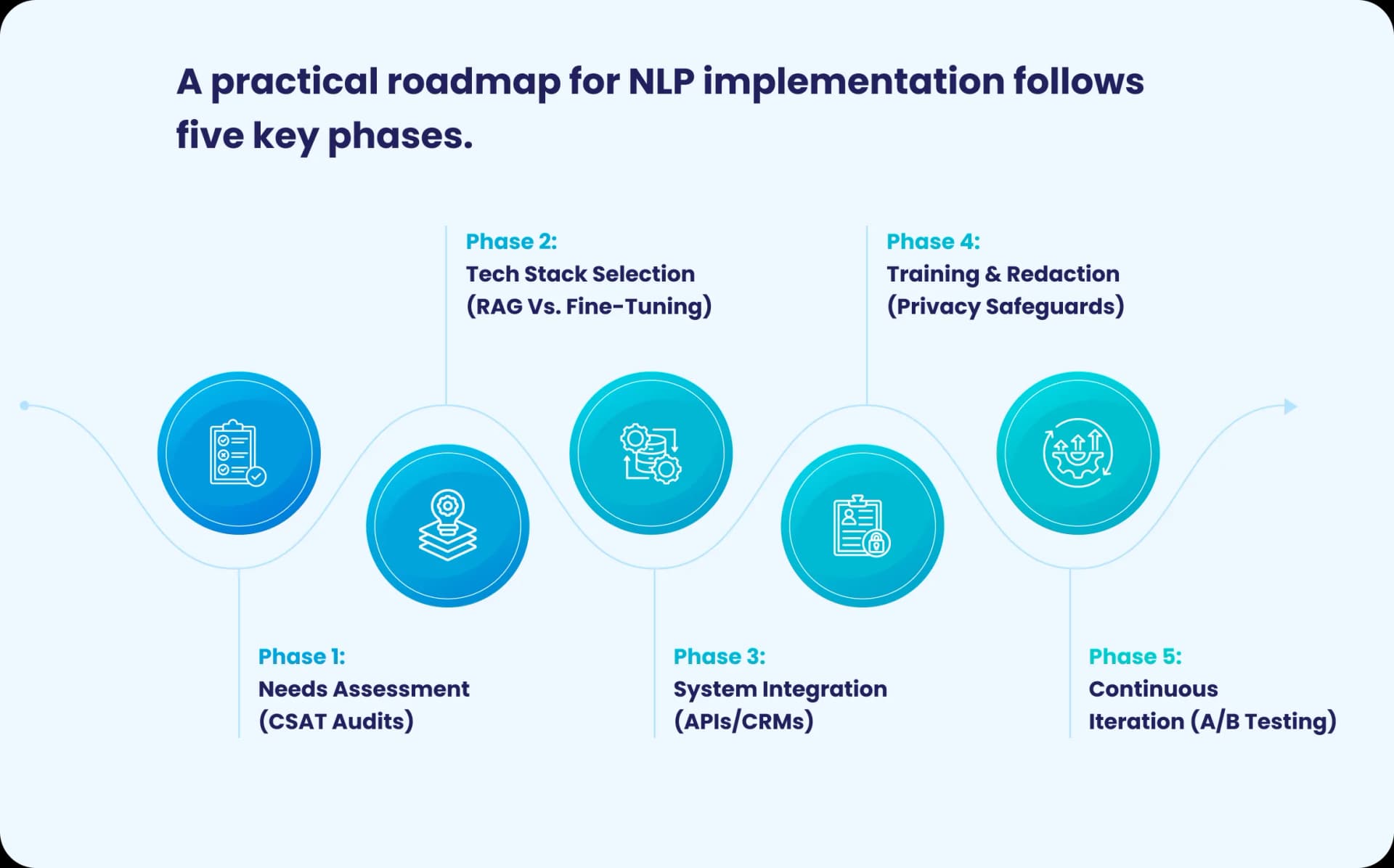
Start by evaluating your current processes through customer satisfaction audits to uncover pain points where AI can create the most impact, such as improving efficiency, reducing errors, or enhancing personalization. Next, select the technology stack that aligns with your goals by choosing between Retrieval-Augmented Generation for dynamic knowledge access, fine-tuned models for domain-specific accuracy, or API-based solutions for flexibility. After that, integrate these tools seamlessly into existing systems using APIs and data pipelines to ensure smooth workflows. Once integration is complete, train your models responsibly with domain-specific data while applying strict redaction protocols to protect sensitive information and maintain compliance. Finally, commit to continuous improvement by leveraging A/B testing and real-world performance insights to refine responses, expand capabilities, and keep pace with evolving customer needs.
The Future of Customer Experience Is Conversational
The customer experience landscape has fundamentally shifted toward hyper-personalized, context-aware interactions powered by sophisticated NLP. Businesses that embrace these technologies report measurable improvements in customer satisfaction while reducing support costs through automation of routine tasks. Forrester anticipates double-digit gains in self-service resolution and workload reductions by 2026.
Looking toward 2027, expect voice-first interfaces to gain dominance as speech recognition and synthesis technologies achieve near-perfect accuracy. Customers will increasingly prefer speaking naturally to AI agents rather than typing, particularly for mobile interactions. Fully autonomous customer service agents capable of handling complex scenarios from initial contact through resolution will become standard at leading companies.
The competitive advantage will belong to organizations that implement NLP thoughtfully, balancing automation efficiency with human empathy where it matters most. Companies should audit their current customer experience technology stack to identify opportunities for AI integration. Start with high-volume, routine interactions that drain human agent capacity while delivering straightforward value to customers. As your NLP systems mature, gradually expand into more complex territory.

Ready to Transform Your Customer Experience with NLP?
We’ll help you map your AI maturity, identify quick wins, and design scalable solutions.
FAQs
Frequently Asked Questions

Table of Contents
Newsletter Signup
Tomorrow's Tech & Leadership Insights in
Your Inbox
Discover New Ideas
7 AI Use Cases South African Enterprises Are Investing In
Using AI Agents in DevOps to Automate CI/CD, Incident Response, & Root Cause Analysis

Is Your AI Actually Secure? What Enterprise Leaders Need to Know in 2026

Knowledge Hub