


The Future of AI in Digital Transformation: Key Strategies for 2026
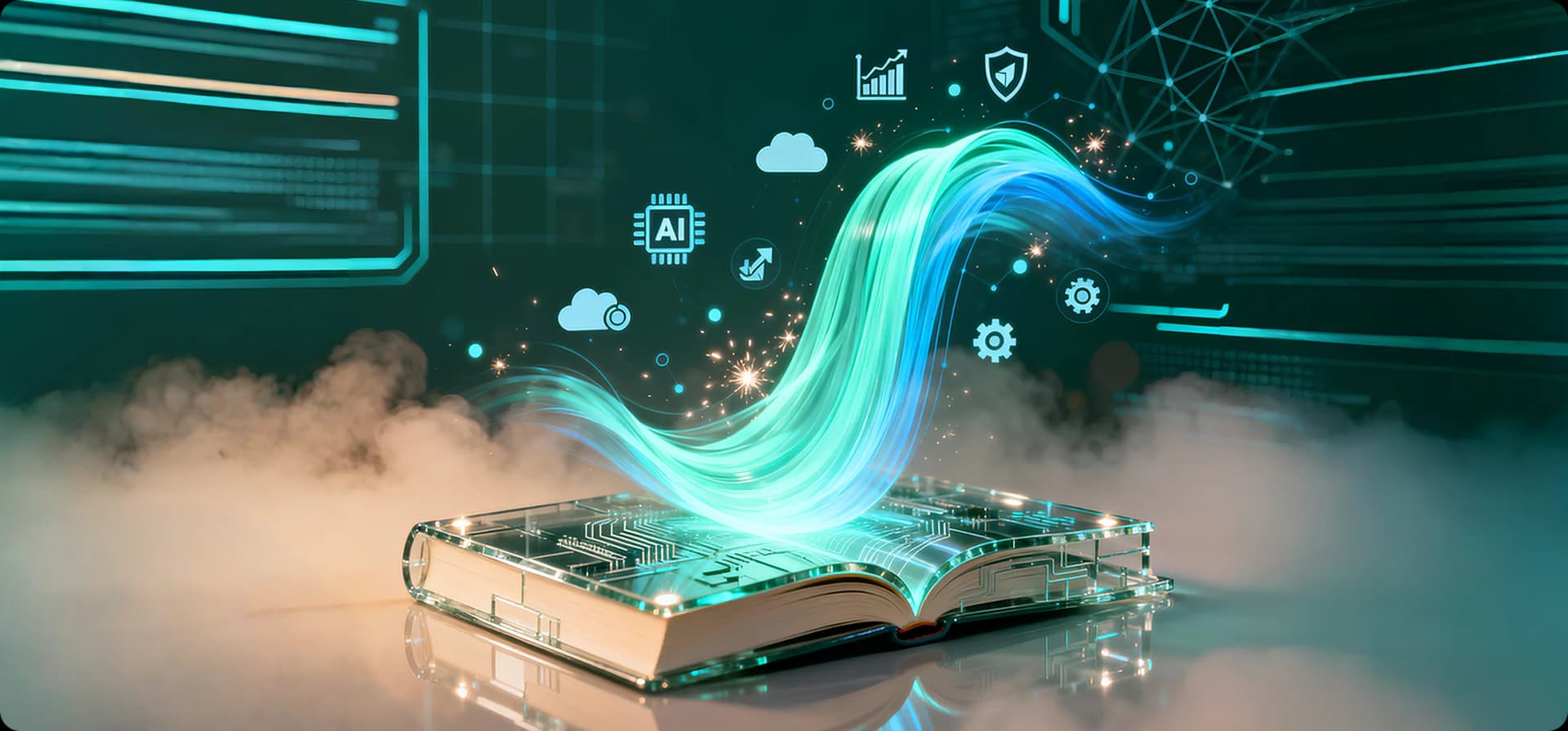
The AI landscape is changing fundamentally. While 2025 focused on chatbots and content generation, 2026 demands autonomous systems that execute complete workflows within secure, controlled environments. Organizations that adapt will gain measurable advantages. Those that don't will fall behind competitors who've already made the shift from "AI as a tool" to "AI as the infrastructure."
Strategy #1: The Rise of Agentic Orchestration
Agentic AI represents autonomous systems that plan, execute, and complete multi-step workflows without constant human intervention. Unlike chatbots that respond to queries, agentic systems function as digital workers capable of understanding goals, breaking them into tasks, and delivering outcomes across organizational silos.
The technical foundation is Chain-of-Thought reasoning. Modern AI models can now externalize their decision process, showing how they moved from instruction to completion. This creates audit trails and builds trust, both critical factors for enterprise deployment.
Consider procurement workflows. A 2025 chatbot answers "Who are our top steel suppliers?" An agentic system receives "Reduce Q2 steel costs by 15% while maintaining delivery schedules" and autonomously analyzes purchasing data, evaluates suppliers, simulates scenarios, and delivers an actionable plan with risk assessments.
The 2026 Paradigm Shift: Human-on-the-Loop
The critical evolution is moving from "Human-in-the-Loop" to "Human-on-the-Loop" for high-volume operational tasks. Rather than approving every action, humans monitor agent performance, intervene when exceptions occur, and adjust parameters based on outcomes. This shift enables true operational scale.
Gen AI 2025 vs. Agentic AI 2026
| Capability | GenAI 2025 | Agentic AI 2026 |
|---|---|---|
| Function | Search, summarize, generate | Plan, execute, complete workflows |
| Interaction | Query-response | Goal-outcome |
| Complexity | Single-step tasks | Multi-step processes across silos |
| Authority | Suggests options | Makes decisions within parameters |
| Integration | Single interface | Orchestrates multiple systems |
| Human Role | Human-in-the-Loop (approves each action) | Human-on-the-Loop (monitors performance) |
| Value | Information efficiency | Operational transformation |
Early adopters report 3x faster operational cycles when deploying agents in supply chain and customer service. The key is identifying workflows with high repetition and moderate complexity, where automation delivers ROI without requiring artificial general intelligence.
What is Agentic Orchestration?
Agentic Orchestration refers to the coordination of multiple AI agents working together to complete complex business processes. Each agent specializes in specific tasks (data retrieval, analysis, execution) while a master orchestrator ensures coherent workflow completion.
Strategy #2: Sovereign AI & The Data "Clean Room" Architecture
As we move toward 2026, the era of "sending data to a black box" is ending.
The initial rush of using public LLM APIs is being replaced by Sovereign AI, a strategic framework where organizations retain 100% ownership over their models, weights, and, most importantly, their data.
For the enterprise, digital transformation now hinges on the ability to train and deploy models within a protected perimeter, ensuring that proprietary intelligence never leaks into a competitor's training set.
What is Sovereign AI?
Sovereign AI refers to a nation or organization's ability to produce artificial intelligence using its own infrastructure, data, and workforce. In an enterprise context, it means hosting models locally or in a private cloud to maintain total data residency and regulatory compliance.
The driver is regulatory compliance, not technological preference. The EU AI Act, which reached full enforcement in 2025, imposes strict requirements on high-risk AI systems. Similar frameworks exist across jurisdictions. Organizations in regulated industries discovered that cloud AI created compliance nightmares - every API call potentially requiring documentation, consent management, and cross-border data flow assessments.
The Role of Data Clean Rooms in AI Orchestration
The biggest bottleneck for AI in 2026 is secure data access. To solve this, leading organizations are implementing Data Clean Rooms (DCRs).
What is a Data Clean Room? A Data Clean Room s a secure, privacy-safe environment where multiple data sources (your customer CRM and a partner's behavioral data) can be joined for AI training and analysis without either party seeing the other's raw PII (Personally Identifiable Information).
Key capabilities include:
- Privacy-Preserving Computation: Using techniques like Differential Privacy and Homomorphic Encryption, DCRs allow AI to learn from sensitive datasets while keeping individual identities mathematically invisible. The AI gains insights from patterns without exposing individual records.
- The End of "Shadow AI": By providing a governed sandbox environment, engineering teams can experiment with high-risk data without violating GDPR, CCPA, or emerging 2026 AI regulations. This controlled experimentation accelerates innovation while maintaining compliance.
- Multi-Party Collaboration: DCRs enable secure data partnerships. A retailer and manufacturer can jointly train demand forecasting models using combined datasets without exposing proprietary customer lists or pricing strategies to each other.
Sovereign AI solves compliance through:
- On-Premises Model Deployment within data centers or virtual private clouds.
- Federated Learning that trains models without centralizing data.
- Confidential Computing using hardware-based secure environments.
- Synthetic Data Generation creating representative datasets without privacy concerns.
Organizations investing in clean rooms report better model accuracy, fewer errors, and faster deployment of new AI applications.

Strategy #3: Digital Twins of the Organization
Digital Twins are moving beyond physical assets into organizational modeling. While manufacturing has used digital twins to simulate equipment performance for years, 2026 expands this concept to human behavior, business processes, and entire organizational systems.
What is a Digital Twin of the Organization (DTO)?
A DTO is a virtual representation of your enterprise that simulates how people, processes, and systems interact. It uses real-time data to model organizational behavior, predict outcomes, and test strategies before real-world implementation.
The Three Types of Organizational Twins
- Process Twins: model workflows end-to-end, showing bottlenecks, dependencies, and failure points. Before redesigning your customer onboarding process, a process twin simulates the impact on completion rates, resource allocation, and customer satisfaction.
- Human Digital Twins: represent behavioral patterns of customer segments or employee groups. Rather than launching a marketing campaign and measuring results, organizations test campaigns against human twins that replicate actual customer decision-making patterns based on historical data.
- System Twins: integrate both process and human elements to model entire business systems. When considering a new pricing strategy, a system twin simulates competitive responses, customer reactions, operational impacts, and revenue outcomes across multiple scenarios.
Strategic Applications in 2026
Organizations use DTOs to:
- Stress-test new products: against simulated customer populations before launch
- Optimize resource allocation: by modeling operational scenarios
- Train AI agents: in simulated environments before production deployment
- Predict change impact: when implementing new technologies or processes
- Accelerate innovation: by rapidly testing hypotheses without real-world risk
A financial services firm used human digital twins to test a new mobile banking interface against simulated customer segments. The twin predicted a 23% drop in adoption among users over 55 due to navigation complexity. Interface modifications based on twin feedback resulted in actual adoption exceeding targets by 18%.
The DTO strategy reduces risk, accelerates decision-making, and creates feedback loops where real-world outcomes continuously improve twin accuracy.
Strategy #4: Why Your 2025 Data Lake Becomes a 2026 Bottleneck
Traditional data lakes were designed for batch analytics and human-driven exploration, not for real-time, semantically-aware requirements of agentic AI systems. File-based storage with hierarchical folders works for business intelligence but fails when agents need rapid, contextual retrieval across heterogeneous sources.
Modernizing to an AI-First Tech Stack
The 2026 infrastructure requires specific architectural components:
- Vector Databases: organize data by semantic meaning rather than explicit attributes. When an agent needs "customer complaints about delivery delays in Q4," vector databases retrieve semantically similar content without complex queries. This powers Retrieval-Augmented Generation (RAG), giving models real-time access to current, proprietary information.
- Knowledge Graphs: capture explicit relationships between entities: customers connect to purchases, which link to products, which relate to suppliers. Graph structures enable reasoning that flat databases cannot match. When understanding "Which customers are affected if Supplier X fails?" graph traversal efficiently identifies dependencies.
- Graph Machine Learning: combines graph structures with neural networks, identifying patterns in relationships. This powers fraud detection, recommendation systems, and supply chain optimization.
| Infrastructure Component | 2025 Approach | 2026 Requirement |
|---|---|---|
| Data Storage | Hierarchical file systems | Vector embeddings + Knowledge graphs |
| Retrieval Method | SQL queries, full-text search | Semantic similarity, relationship traversal |
| Update Frequency | Batch processing (hourly/daily) | Real-time streaming |
| Query Latency | Seconds to minutes | Milliseconds |
| AI Integration | Manual ETL pipelines | Native AI-optimized formats |
The migration pathway doesn't require abandoning existing infrastructure. Layer vector search alongside current warehouses, build domain-specific knowledge graphs for high-value use cases, then implement hybrid architectures routing different queries to appropriate backends.
Strategy #5: Building Change Fitness for AI-Augmented Organizations
Change Fitness refers to organizational capacity to absorb, adapt to, and derive value from technological transformation. While AI capabilities have advanced dramatically, the primary constraint on enterprise value is organizational adoption.
Research shows 70% of enterprise AI projects fail to progress beyond pilots because organizations struggle with human dimensions. Employees resist workflows that feel surveillance; managers hesitate to trust algorithms over intuition, and executives withdraw support when quick wins don't materialize.
The Human-on-the-Loop Framework
Successful AI transformation restructures how humans and algorithms collaborate:
- Graduated Autonomy: Systems begin with narrow authority and earn expanded scope through demonstrated reliability. A customer service agent might draft responses for approval, then handle routine questions autonomously, eventually managing full conversations with exception handling.
- Explainability: Employees trust recommendations when they understand reasoning. Modern systems articulate why decisions were made, which data informed them, and what alternatives were considered.
- Override Mechanisms: Humans need straightforward ways to correct mistakes. When corrections occur, feedback should immediately improve system behavior through model retraining.
- Task Augmentation Over Job Replacement: Frame AI as helping employees do jobs better, not replacing them. AI handles tedious work (data entry, status updates) while humans focus on judgment-intensive activities (relationship building, strategy, problem-solving).
Developing Organizational Readiness
Building change fitness requires:
- Executive Sponsorship: beyond budget approval to active modeling of AI use
- Manager Enablement: helping front-line leaders integrate AI into daily operations
- Skills Development: establishing AI literacy as baseline competency
- Process Redesign: reimagining workflows from first principles
- Metrics and Incentives: measuring and rewarding adoption behaviors
A manufacturing enterprise deploying AI-driven scheduling initially met resistance from plant managers. By involving managers in system design, providing transparent explanations, operating in advisory mode initially, and demonstrating results, the organization achieved 40% reduction in schedule-related delays and 23% improvement in on-time delivery. Success stories spread organically, creating momentum for broader adoption.
Conclusion: Preparing for the Agentic Era
The shift from generative to agentic AI demands more than new technology. Success requires reimagined data architectures built on sovereign principles, secure collaboration through Data Clean Rooms, digital twin simulations for risk-free testing, and organizational capabilities for algorithmic orchestration.
Organizations that thrive will master core competencies: technical sophistication deploying autonomous agents safely within sovereign infrastructure, data maturity providing reliable knowledge foundations through modern tech stacks, simulation capabilities using digital twins to test before executing, and change fitness transforming human roles from AI users to AI orchestrators.
The future belongs to organizations that integrate AI into operational fabric as core infrastructure, creating advantages competitors cannot rapidly replicate. That journey begins with strategic choices made today, such as prioritizing orchestration maturity, data sovereignty, organizational readiness, and simulation-driven strategy over simple AI adoption.

Audit Your Agentic Readiness for 2026
Connect with our experts to evaluate your current AI stack and design a scalable roadmap for the year ahead.
FAQs
Frequently Asked Questions

Table of Contents
Newsletter Signup
Tomorrow's Tech & Leadership Insights in
Your Inbox
Discover New Ideas
7 AI Use Cases South African Enterprises Are Investing In
Using AI Agents in DevOps to Automate CI/CD, Incident Response, & Root Cause Analysis
Is Your AI Actually Secure? What Enterprise Leaders Need to Know in 2026

Knowledge Hub