


Why Most Enterprise AI Projects Stall After the Pilot (And How to Fix It)

The numbers tell an uncomfortable story. According to recent industry analyses, between 80% and 95% of enterprise AI initiatives never make it past the experimental phase. Billions are being invested in artificial intelligence, yet most organizations find themselves trapped in what insiders call "Pilot Purgatory": a liminal space where proof of concepts succeed on paper but fail to deliver meaningful business value.
This isn't a technology problem. The AI works. The models are sophisticated, the algorithms are sound, and the predictions are often accurate. The failure happens elsewhere, in the unglamorous space between a working demo and a production system that actually changes how work gets done.
Most analyses of AI failure focus on data quality issues. While data problems are real, they are symptoms of a deeper issue: organizations are approaching AI deployment backwards. They're starting with the technology and trying to fit it into existing operations, rather than redesigning operations around the outcomes they need.
This article examines why enterprise AI projects fail to scale and, more importantly, provides a practical framework for moving from experimentation to measurable return on investment. We're not offering another list of best aspirational practices. Instead, we're documenting the operational patterns that separate successful AI implementations from expensive science projects.
The Silent Killers of AI Scalability
Understanding why AI pilots fail requires looking beyond the usual suspects. Four specific barriers prevent most organizations from scaling their AI investments.
The Sandbox Illusion
Pilot projects operate in controlled environments with curated datasets. A customer service AI might be trained on six months of carefully selected support tickets, all properly categorized and cleaned, achieving high performance like 92% accuracy in predicting customer intent.
Real customer messages in production arrive with typos, mixed languages, and references to products absent from training data, creating data streams with different characteristics than historical batches.
Edge cases rare (e.g., 0.1%) in pilots become frequent at scale, amplifying failures with issues like poor labeling and eroding accuracy from pilot benchmarks.
MIT's 2025 analysis (The GenAI Divide) links 95% of pilot stalls partly to such data quality gaps, where models overfit controlled demos but collapse under production variability.
The gap between pilot and production extends beyond technical issues to operational ones: pilots use static snapshots, while production demands handling evolving reality, data drift, integration challenges, and business inconsistencies.
The Learning Gap
Most AI pilots are built as static systems. A model is trained, validated, and deployed. Then it sits unchanged, making predictions based on patterns it learned months ago. Meanwhile, the business context shifts. Customer behavior changes. Market conditions evolve. The product mix expands. New competitors emerge.
Within months, model performance degrades. The AI that once provided valuable insights now produces recommendations that feel increasingly disconnected from current reality. Without mechanisms for continuous learning and recalibration, even well designed models become obsolete faster than traditional software.
The Workflow Mismatch
This is where most AI scaling efforts actually break down. Organizations treat AI as an addition to existing processes rather than a catalyst for redesigning them. The result is predictable: friction, workarounds, and eventual abandonment.
Consider a logistics company that deploys an AI system to optimize delivery routes. The model generates superior routes compared to human planners, reducing estimated drive time by 18%. But the system requires drivers to input data in a new format, doesn't integrate with the existing dispatch software, and can't account for the informal knowledge drivers have about loading dock access or traffic patterns at specific locations.
Drivers start ignoring the AI recommendations. Not because the routes are wrong, but because following them creates more work than they eliminate. The AI is technically successful but operationally useless. You cannot install an advanced engine into an incompatible chassis and expect improved performance. You just damage both the engine and the chassis.
The Ownership Dilemma
AI pilots are typically owned by IT, data science teams, or innovation labs. These groups have the technical expertise to build and validate models. But they don't live with the operational consequences of the systems they create.
When the pilot phase ends, the technical team moves to the next project. The operational team that's supposed to use the AI daily finds themselves supporting a system they didn't design, don't fully understand, and that doesn't quite fit their workflow. Without ongoing technical support and iteration, they revert to familiar tools and processes. The AI becomes shelfware, expensive and unused.
This ownership gap is particularly problematic because operational teams are best positioned to identify when AI outputs are wrong, which edge cases matter most, and where the system creates unintended bottlenecks. Without their engaged participation, you lose the feedback loop necessary for the system to improve.
The Real Issue isn’t AI, it’s the Process
The most successful AI implementations start with a counterintuitive insight: building better AI systems requires focusing less on the AI itself and more on the business processes it's meant to improve.
Organizations fail when they ask "Where can we apply AI?" Success comes from asking "Which decision making bottleneck is costing us significant money or time, and could AI help eliminate it?"
The difference is subtle but crucial. The first question leads to technology looking for problems. The second leads to problems that might benefit from technological solutions.
Pilot Purgatory vs. Production Success: What Actually Separates Them
To understand what differentiates stalled pilots from successful deployments, consider how organizations approach each critical dimension:
| Dimension | Projects Stuck in Pilot Purgatory | Projects That Scale Successfully |
|---|---|---|
| Starting Question | "Where can we use AI?" | "Which $10M problem should we solve?" |
| Success Metrics | Model accuracy, F1 scores, technical performance | Hours saved, revenue increased, costs reduced |
| Data Strategy | Clean all data before starting | Build pipelines for specific problem data |
| Timeline | 6+ months to show value | 8 to 12 weeks to demonstrate impact |
| Ownership | IT builds, Operations uses | Hybrid team owns both build and outcomes |
| Integration Approach | Add AI to existing workflow | Redesign workflow around AI capabilities |
| User Involvement | End users see system after it's built | End users co-design from day one |
| Post Launch Plan | Deploy and move to next project | Continuous monitoring and improvement |
| Risk Tolerance | Avoid changing established processes | Willing to redesign work for better outcomes |
| Value Definition | Proves technology works | Proves technology creates business value |
The patterns are clear. Organizations that escape Pilot Purgatory treat AI as a business transformation tool, not a technology experiment. They start with outcomes, involve operational staff throughout, and commit to ongoing evolution rather than one time deployment.
Reverse Engineering Value
Consider two approaches to the same challenge in supply chain management. A manufacturer wants to improve procurement efficiency.
The AI first approach goes like this: deploy a demand forecasting model that predicts component needs with 85% accuracy. The model works. It generates predictions. But procurement staff still spend hours each week reviewing the predictions, cross referencing them with supplier availability, checking inventory levels across multiple systems, and manually drafting purchase orders. The AI provided information, but it didn't change the work. Forecast accuracy improved, but procurement costs didn't decrease.
The process first approach starts differently. Map the current procurement workflow end to end. Identify that procurement staff spend 60% of their time on routine purchase orders for standard components. The workflow requires pulling data from four different systems, checking approval levels, and formatting orders to match supplier requirements.
Now redesign the process: the AI doesn't just predict demand, it monitors inventory levels in real time, automatically generates draft purchase orders when thresholds are met, routes them through the appropriate approval chain, and formats them according to supplier specifications. Humans review and approve rather than draft from scratch. The result is 40% time savings on routine procurement, allowing staff to focus on strategic supplier relationships and complex purchases.
The key distinction is agency versus accuracy. A model that predicts is interesting. A system that acts, with appropriate human oversight, is profitable.
The Value of Human in the Loop Design
The most effective AI systems aren't fully automated. They're designed around a carefully considered handoff between AI and human judgment. When should the system act autonomously? When should it flag a decision for human review? How does it communicate confidence levels?
A credit approval system that tries to fully automate decisions will either be too conservative, rejecting profitable customers, or too aggressive, increasing default risk. A system designed to handle straightforward cases automatically while routing complex or borderline applications to human underwriters can process higher volumes while maintaining credit quality.
This hybrid approach does something else valuable: it builds trust. When staff see that the AI acknowledges uncertainty and defers to human expertise in ambiguous situations, they're more likely to trust it when it does make autonomous decisions. Trust is the foundation of adoption, and adoption is the foundation of ROI.
A Roadmap to Production
Moving AI from pilot to production requires a structured approach that addresses both technical and organizational challenges.
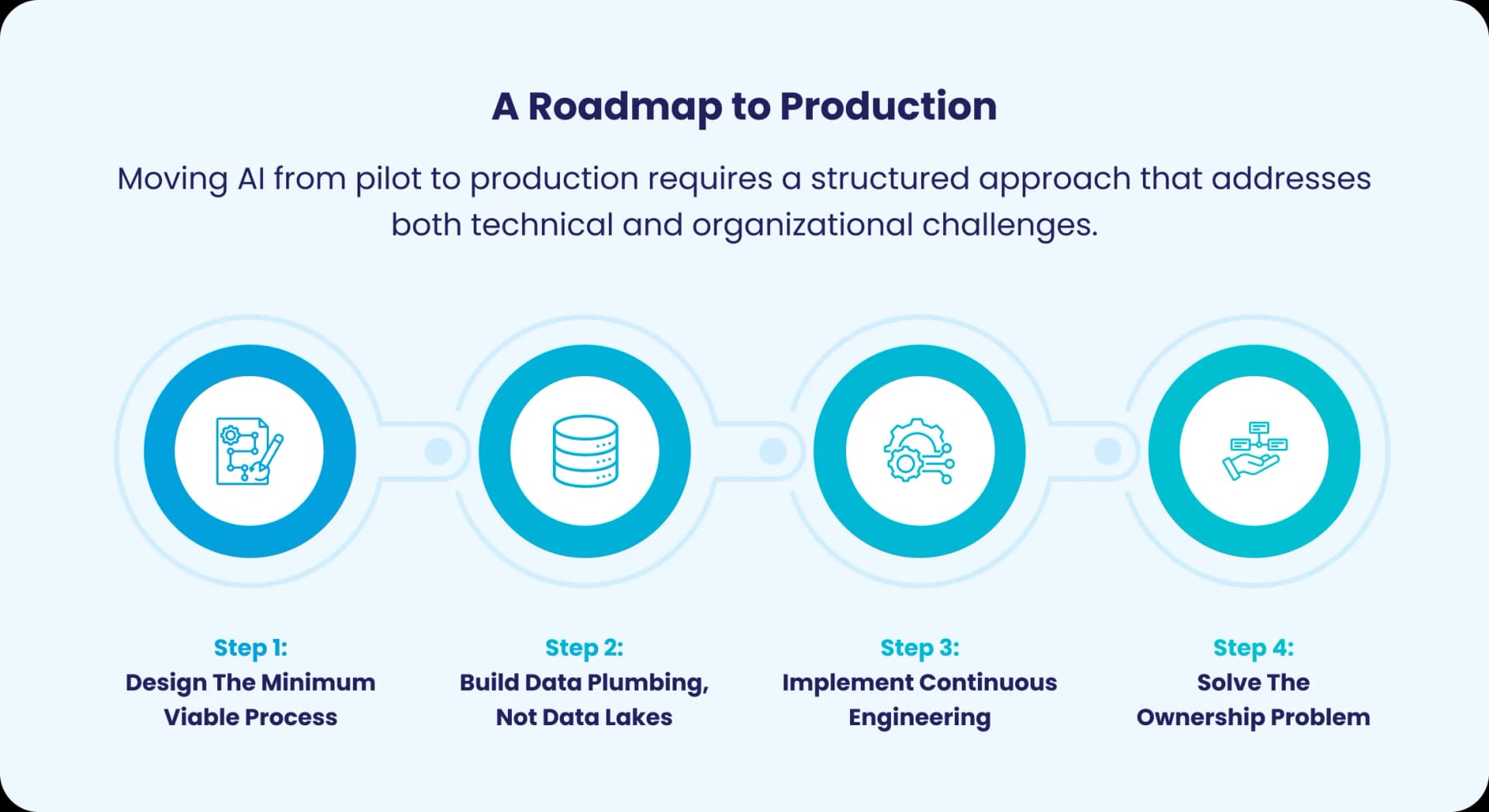
Step 1: Design the Minimum Viable Process
Before training a model, map what the ideal workflow would look like if the AI worked perfectly. Which steps would be eliminated? Which decisions would be automated? Where would humans still add irreplaceable value?
This exercise forces clarity about what success actually means. It reveals whether you're solving a valuable problem or just demonstrating technical capability. It also identifies integration points, data requirements, and potential resistance points before significant resources are committed.
If you can't articulate a clear before and after process map, with quantified improvements in specific business metrics, you're not ready to build anything.
Step 2: Build Data Plumbing, Not Data Lakes
One of the most common reasons AI pilots stall is the belief that you need perfect, comprehensive data before starting. Organizations launch multi year data lake initiatives, trying to clean and consolidate everything.
This is both unnecessary and counterproductive. You don't need all your data perfect. You need reliable pipelines for the specific data relevant to the problem you're solving.
Focus on building robust data infrastructure for the vertical slice you need right now. Ensure that data flows reliably from source systems to your AI, that quality issues are caught and handled gracefully, and that the system can adapt when data formats change. This targeted approach delivers value in months instead of years.
Step 3: Implement Continuous Engineering
AI systems aren't like traditional software that you install and update quarterly. They're more like employees who need ongoing training and development. Model performance degrades over time as the world changes. New edge cases emerge. Business priorities shift.
Plan for continuous monitoring and recalibration from day one. Establish metrics that matter, not just technical measures like model accuracy but operational metrics like user adoption rates, time savings, and error rates. Build mechanisms to identify when performance degrades and processes to retrain or adjust models.
Organizations that treat AI deployment as a project with a defined end date usually see their systems become progressively less useful. Those that treat it as an ongoing operational capability maintain and extend value over time.
Step 4: Solve the Ownership Problem
Successful AI implementations require clear ownership that spans technical and operational domains. Someone needs to be accountable for both whether the system works technically and whether it delivers business value.
This often means creating new hybrid roles or teams that combine technical AI expertise with operational business knowledge. It means establishing service level agreements not just for system uptime but for business outcomes. It means building feedback loops so operational staff can quickly report issues and see them addressed.
Without this organizational infrastructure, even technically excellent AI systems fail because no one is accountable for making sure they continue to deliver value as conditions change.
Moving From Experimentation to Transformation
The difference between organizations trapped in Pilot Purgatory and those generating real value from AI isn't usually technical sophistication. It's operational maturity. It's the willingness to redesign work rather than just augment it. It's the discipline to start with business outcomes and work backwards to technology rather than the reverse.
AI scaling succeeds when organizations treat it not as an IT project but as a business transformation that happens to use AI. That means involving operational staff from day one, designing workflows before training models, building for continuous evolution rather than static deployment, and measuring success in dollars and hours rather than accuracy percentages.
The pilot phase is comfortable. It's low risk, contained, and allows organizations to explore AI without committing to significant change. But meaningful value requires leaving that comfort zone. It requires moving from "Can we do this?" to "Should we do this, and if so, how do we make it part of how we actually work?"
The organizations that answer those questions honestly and act on the answers are the ones turning AI investments into competitive advantages. Those that remain stuck in endless pilots are funding their competitors' transformation.
If your AI initiative has been in the pilot phase for more than six months, you don't have a technology problem. You have a decision problem. The question isn't whether the AI works. It's whether you're ready to change how you work.

Ready to Move Your AI Projects from Pilot to Production?
Redesign workflows for AI integration, build operational frameworks that scale, and transform proof of concepts into measurable business outcomes.
FAQs
Frequently Asked Questions

Table of Contents
Newsletter Signup
Tomorrow's Tech & Leadership Insights in
Your Inbox
Discover New Ideas

7 AI Use Cases South African Enterprises Are Investing In

Using AI Agents in DevOps to Automate CI/CD, Incident Response, & Root Cause Analysis

Is Your AI Actually Secure? What Enterprise Leaders Need to Know in 2026

Knowledge Hub