


AI in Banking: Where It Works, What It Takes, and Why Getting It Right Matters

Key Takeaways
- AI in banking delivers measurable returns in credit, compliance, customer operations, and branch intelligence, when deployed on clean data with human oversight.
- McKinsey projects 15-20% net cost reduction across the banking sector as AI scales across operations.
- Loan processing times have dropped by up to 80% in institutions with mature AI credit deployments.
- Computer vision is enabling a new generation of intelligent branch operations — from frictionless KYC to real-time queue management.
- In 2025, the world's 50 largest banks announced over 160 agentic AI use cases, with early deployments cutting manual workloads by 30–50%.
- The institutions seeing consistent ROI share one approach: bank-wide architecture before use-case experimentation.
- Human-in-the-loop design is not a constraint; It is the mechanism that keeps AI trustworthy at scale.
Banking has always been an information-intensive business. Every credit decision, every compliance check, every customer interaction generates data. For most of the industry's history, the capacity to act on that data was bounded by human bandwidth. AI is changing that constraint by significantly extending what a well-structured institution can do with the data it already holds.
The opportunity is large. McKinsey estimates generative AI alone could add up to $340 billion in annual value to the banking sector — primarily through enhanced risk management, operational automation, and improved customer decision-making. But the evidence also shows that realising that value is harder than most pilots suggest. Deloitte's 2024 Financial AI Adoption Report found that only 38% of AI projects in finance meet or exceed their ROI expectations.
That gap between potential and realisation is the most important thing for any bank's leadership to understand before making significant AI commitments.
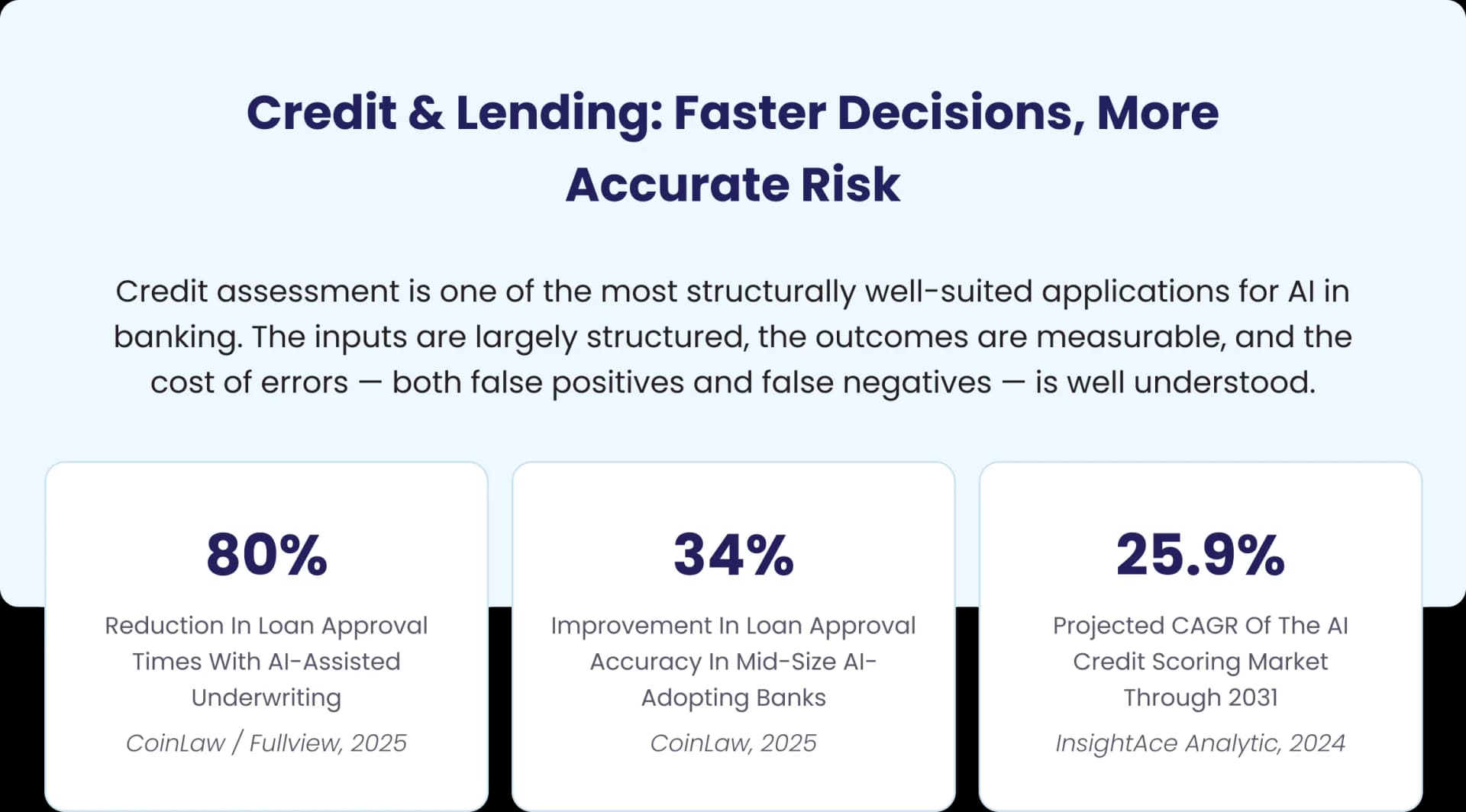
Traditional credit scoring draws from a narrow set of variables, including payment history, income and outstanding liabilities.
AI credit models can analyse hundreds of variables simultaneously, including non-traditional signals such as utility payments, rent history, and transaction behaviour patterns, hence expanding credit access while improving risk accuracy. For markets where thin credit files have historically been a barrier, this is a meaningful structural shift.
The caveat worth noting: a McKinsey survey of 44 financial institutions found that more than two in five have slowed AI use-case development because of disappointing outcomes, often linked to rushing deployment without sufficient model validation. The speed gains in credit processing are real, but they require robust testing environments and ongoing model governance to hold.

Implementation note
AI credit models perform best when trained on institution-specific historical data rather than generic datasets. Generic models calibrated for one market often produce systematically biased outputs when applied to different borrower populations — a risk that requires structured validation before any model goes live at scale.
Compliance & Reg Tech: Reducing the Cost of Getting It Right
Regulatory compliance is one of the largest cost centres in banking. It is also one of the clearest productivity opportunities for AI because much of compliance work involves highly repetitive pattern-matching against large volumes of documented transactions and disclosures.
Institutions using AI for compliance and settlement processes report cost reductions of up to 40%, according to BCG research. Separately, over one‑third of organizations now automate a majority of their compliance tasks using AI, with the most mature deployments delivering significant reductions in reporting and audit preparation time, according to recent compliance automation surveys.
Generative AI is already being used to draft regulatory reports, synthesise policy documentation, and flag anomalies across transaction data — work that previously required teams of analysts. The productivity improvement is most pronounced in AML screening, KYC documentation review, and audit trail generation.
The governance consideration here is significant. Regulators across most jurisdictions now expect explainability from AI-driven compliance decisions. That means black-box models are not appropriate for this domain. Institutions deploying AI in compliance workflows need audit-ready decision trails as a design requirement, not an afterthought.
Customer Operations: Precision Over Volume
The most visible AI applications in customer-facing banking have been conversational, including chatbots, virtual assistants and personalised alerts. The evidence here is more mixed than in credit or compliance, largely because customer expectations are high and tolerance for AI errors in service interactions is low.
What does work well is using AI to inform and accelerate human customer interactions, rather than to replace them entirely. AI-enhanced onboarding systems have reduced average customer onboarding times by around 50%, compressing processes from 20 to 30 minutes to under 10 mins, while increasing data accuracy through automated validation and reduced manual entry. Banks deploying AI-assisted onboarding also report material improvements in early-stage customer retention, with some seeing up to a 30% uplift within the first six months, reflecting both better customer experience and more reliable onboarding workflows
Bank of America's Erica assistant handles millions of customer interactions monthly, providing personalised financial insights and proactive account notifications — a use case that works because the scope is narrow and well-defined. The model does not speculate; it retrieves and summarises structured account data. That specificity is what makes it reliable.
Wealth and asset management is seeing particularly strong returns from AI adoption. At firms like JPMorgan, AI-enabled advisor tools helped drive a 20% increase in gross sales in asset management between 2023 and 2024, while allowing advisors to expand client coverage. Critically, AI functions as an analytical layer ahead of advisor conversations—synthesising portfolio data, market signals and client history—rather than operating during live client interactions. This model preserves human judgment while materially improving advisor productivity and commercial outcomes.
Branch Banking: Intelligent Environments, Not Just Digital Channels
Physical banking is evolving. And one of the least-discussed but most operationally significant applications of AI in banking sits inside branches:
Computer vision:
Computer vision systems in branches can analyse customer flow in real time, identify congestion points, measure service wait times, and generate staffing recommendations dynamically, converting camera feeds that previously existed only for security into operational intelligence assets.
| Application | What it does | Measurable outcome |
|---|---|---|
| KYC document verification | Authenticates identity documents and matches facial biometrics at account opening | KYC time reduced from hours to minutes |
| Queue and flow analytics | Tracks foot traffic, wait durations, and peak demand patterns across branch areas | Dynamic staff allocation; measurable service level improvement |
| ATM monitoring | Detects physical tampering, suspicious behaviour, and maintenance needs in real time | Reduced fraud incidents and downtime |
| Personalised service triggers | Identifies priority or returning customers upon branch entry for proactive engagement | Improved customer satisfaction scores |
| Document processing (OCR) | Extracts and classifies data from physical forms, contracts, and financial documents | 50% reduction in processing cost reported at scale |
OCBC Bank has deployed facial recognition across its ATM network, processing two million monthly withdrawals with no PIN required — a frictionless authentication model that simultaneously improves security and customer experience. In parallel, BBVA demonstrated that computer vision-enabled KYC verification, conducted via video call, reduces the account opening process from hours to minutes.
These are examples of production systems generating measurable operational outcomes that point toward a version of branch banking that is more efficient, more personalised, and more secure than what most institutions currently operate.
The Architecture That Makes It Work
The institutions achieving consistent, scalable returns from AI share a structural approach that distinguishes them from those running isolated pilots. McKinsey's analysis identifies five markers of high-performing AI banks: a bank-wide AI vision with measured ROI, a full-stack approach combining generative AI with analytical AI, domain-level reimagination of workflows, multi-agent systems for complex processes, and reusable AI components rather than point-in-time builds.
The data infrastructure question comes first. AI models are only as reliable as the data they are trained and operated on. Fragmented data, such as, inconsistent across core banking systems, CRM platforms, and risk engines, produces unreliable model outputs, regardless of model sophistication. This is not a technology problem; it is a data governance problem that requires executive-level commitment to resolve.
Human-in-the-loop design is the second non-negotiable. In credit decisions above certain thresholds, in compliance determinations with regulatory consequence, and in customer-facing communications, AI should function as a decision-support layer, not a final decision-maker. The institutions that pushed past early disappointment and continued iterating on AI in credit are the ones now seeing consistent returns, according to McKinsey's chief risk officer research. Those that prioritised early ROI above model quality were more likely to abandon programmes prematurely.
BCG research shows that organizations building specialist AI teams with deep domain-specific financial expertise—rather than relying on generic machine-learning groups—can unlock up to 60% efficiency gains and 30–40% cost reductions in targeted functions. These gains consistently appear where AI is shaped by people who understand financial products, workflows, and control environments. In this context, domain knowledge is not optional; it is what separates models that perform reliably in production from those that appear effective in pilots but fail under real-world complexity.
What's Changing Right Now: The 2025–2026 Frontier
Three developments from the past twelve months are materially changing what AI can do inside a bank, and how quickly boards need to form a position on them.
Agentic AI
Autonomous Detection
Governed Agentic Workflows
Agentic AI
Agentic AI is moving rapidly from pilot to production in banking. In 2025 alone, more than 160 agentic AI use cases were active across the world’s 50 largest banks, according to McKinsey, with early production deployments already delivering 30–50% reductions in manual workload. One U.S. bank deploying AI agents for credit risk memo generation reported 20–60% productivity improvements and a 30% reduction in credit approval turnaround time, while retaining human decision authority.
At the same time, global market spend on agentic AI reached an estimated $50 billion in 2025, and adoption is accelerating sharply: Wolters Kluwer projects that 44% of finance teams will be using agentic AI by the end of 2026, representing a 600%+ year-on-year increase. Together, these trends point to the most significant architectural shift in banking operations in more than a decade—the move from single-task automation to multi-step, goal-driven autonomous workflows embedded directly into core banking processes.
Autonomous Detection
The shift toward multimodal, autonomous detection is already reshaping how leading banks approach fraud prevention in production systems. This next generation of fraud systems do not analyse transactions alone — they process text, voice, image, and behavioural signals simultaneously. Mastercard's RAG-enabled voice scam detection system, deployed in 2024, achieved a 300% improvement in fraud detection rates. Finastra and others are now describing multimodal threat detection as a core investment priority for 2026, moving institutions from rule-based pattern matching to adaptive, real-time intelligence. For banks deploying computer vision alongside transactional AI, this convergence creates a significantly more robust fraud prevention capability than either system delivers independently.
Governed Agentic Workflows
Governed agentic workflows are becoming a competitive differentiator. The question of how to deploy autonomous AI within a regulated environment — without sacrificing auditability or control — is being answered in production. Bradesco's Bridge platform, built on Azure AI, enforces consistent governance policies across agentic workflows through a governed API layer, achieving 83% digital service resolution rates and a 30% reduction in technology costs. This model — agentic AI operating within a structured control architecture, not outside it — is the template that regulators are likely to favour, and that institutions should be designing toward now.
Taken together, these developments point in one direction: the baseline for what constitutes a mature AI deployment in banking is moving quickly. Institutions benchmarking against 2023 deployments are measuring against a receding standard.
The Competitive Context
McKinsey's analysis of approximately 4,000 fintechs shows that incumbent banks trail fintechs significantly in deploying AI with measurable business impact — not because of model access (both have it) but because fintechs move faster from experimentation to production deployment and face fewer legacy integration constraints.
92% of global banks report active AI deployment in at least one core banking function. But deployment breadth is not the same as deployment depth. The majority of those deployments remain in pilot or single-function mode. The competitive pressure from fintech and from AI-native neobanks is a present threat, and one that is accelerating.
McKinsey's Global Banking Annual Review 2025 projects that AI-driven cost savings will compress margins industry-wide over time, as competitive pressure passes efficiency gains to customers rather than retaining them within institutions. The strategic implication: the banks that move earlier capture cost advantages that later movers will not be able to replicate at the same margin.
Closing Thoughts
AI in banking is neither a silver bullet nor a speculative bet. It is a set of specific, well-understood tools, each with a defined scope of reliability and a known set of failure conditions.
| Application | Use Cases in Banking |
|---|---|
| Gen AI | Document intelligence and customer personalization |
| Predictive Models | Credit and risk scoring |
| Computer Vision | Branch and identity workflows |
| Agentic Systems | Multi step operational processes |
The institutions that will benefit most are those that approach AI as infrastructure rather than initiative. That means treating data quality as a precondition, not a parallel workstream. It means designing human oversight into production workflows from the start. And it means measuring AI performance with the same rigour applied to any other core banking system.
The current question for any bank's leadership is whether the institution is building the underlying conditions — data, governance, domain expertise, and architectural discipline — that allow AI to perform at the level the business case requires.

Working on AI adoption in your institution?
If you're navigating implementation complexity or assessing where to build next, we're happy to think through it with you
FAQs
Frequently Asked Questions

Table of Contents
Newsletter Signup
Tomorrow's Tech & Leadership Insights in
Your Inbox
Discover New Ideas

5 Signs Your Quality Control Process Is Ready for Autonomous Inspection

7 AI Use Cases South African Enterprises Are Investing In

Using AI Agents in DevOps to Automate CI/CD, Incident Response, & Root Cause Analysis

Knowledge Hub